.png)



2026
Eliana is the kind of student who doesn’t just attend Catholic Noles—she helps make it run. A sophomore studying literature, media, and culture, she’s part of the liturgy team and coordinates lectors for student Masses.
This year, something shifted for her. She found herself more involved than ever, drawn in not only by day-to-day life at the ministry, but by the kind of “big moments” that turn acquaintances into friends and friends into family. Events like SEEK—and especially the March for Life—did that for her. “It got me closer to these people,” she shared, “and so now I go there a lot more.”
_edited.png)
Eliana had never been to the March for Life but before she ever stepped into the crowds of Washington, D.C.,
she learned something she didn’t expect: the trip itself is part of the grace.
“It’s almost like a pilgrimage in itself,” she said. “It’s so much more than just going to D.C. and walking around… it’s a whole experience.”
For Eliana, that “whole experience” meant preparing her heart through prayer and Mass, traveling with fellow students, and discovering that standing for life can be both public witness and personal renewal.
When the day of the march arrived, she remembers the mix of waiting, energy, and awe—time that could have felt like an inconvenience, but instead became its own kind of gift. While the crowd waited for the march to begin, she took in the signs, the rosaries, the shared purpose—so many people gathered for one conviction: human life matters.
Catholic Noles stayed together during the March, but what surprised Eliana wasn’t only the size of the crowd—it was the breadth of it. She expected many Catholics, and there were. But she also noticed people she hadn’t expected to see there at all: individuals who didn’t fit the stereotypes people often attach to the pro-life movement.
That moment stayed with her because it challenged the idea that pro-life conviction belongs to one “side.” “A lot of people treat it like a political thing,” she said, but the heart of it is deeper: it’s about “supporting that human dignity… in everyone, especially the unborn.”
And then there was a scene she doesn’t think she’ll ever forget—a moment that captured, for her, what Catholic Noles is all about: faith showing up wherever students are, even in the most unexpected places.
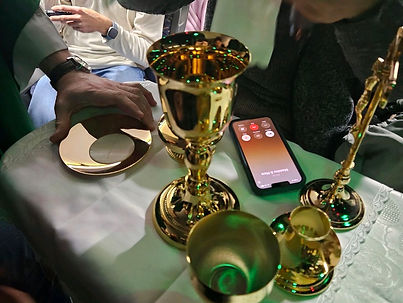
Because of an approaching snowstorm, the group had to leave early. On the trip, Father Chris celebrated an improvised Mass on the bus—an “improv bus mass,” as Eliana called it—and it was “beautiful to experience.”
The sacraments weren’t confined to a church building; they traveled with the students, meeting them right where they were—tired, grateful, and trying to get home safely.

When Eliana looks back on the weekend, she doesn’t talk only about the march. She talks about friendships. She talks about how God was present in the ordinary in-between moments—meals, museums, long conversations—times when she began to “see God so much more clearly” in the people she was growing closer to.
And she talks about what the trip awakened in her spiritually. After the March for Life, Eliana found her relationship with Our Lady of Guadalupe deepening, along with a renewed desire to pray for unborn children and to live what she calls a kind of “spiritual motherhood.”
In a quiet but real way, the pilgrimage shaped her priorities—and strengthened her commitment to the work she’s already doing back on campus.
That’s why, when she’s asked what she’d say to a student on the fence about going next year, her answer is gentle—and bold: go. Not because you have it all figured out, but because God meets people in their willingness. The March matters, she says, but “it’s more than the March,” and even if you’re hesitant, “take a little risk, and see what God does with that.”
For Eliana, the March for Life wasn’t just a trip. It was a witness—one that continues long after D.C., back in dorms, classrooms, and campus sidewalks. And she’s clear about what makes that witness possible: the donors and parish communities who help send students in the first place. By bringing students to the March, she says, you’re not only making a witness in Washington—you’re helping students bring that witness home, “supporting life outside of the March for Life.”